Every now and then while searching for dog pictures for this website I stumble upon pictures of dogs in the dog meat trade. I had no idea about it until a few months ago when I started this website.
The images are pretty rough. Makes me think about a lot of things from our world and our history.
That’s all I have to say for now.
June 6, 2023
I had a dream/nightmare about it. My psyche seems to have taken it in.
Have you ever wondered how a dog sees the world? Not only do they see everything from a much lower perspective, but they also have a different field of view than we do. Because their eyes are set a bit wider than our forward-facing eyes, they can see 250 degrees around themselves, compared to a human’s 190-degree field of view[1]. Dogs also see much better at night and see motion better than humans — but what about how they see colors?
Are Dogs Colorblind?
Dogs are not completely colorblind, but they don’t see as many colors as we do. Dogs have di-chromatic vision, meaning they have two types of cones in their retinas. Humans are tri-chromatic, with three types of cones in the retina, meaning more colors can be interpreted by the brain.
What Colors Can Dogs See?
Dogs can see blue, yellow, and any shades or combination of these colors. If an item has no blue or yellow in it, dogs will see the item in shades of grey (thanks to the rods in their eyes that distinguish light). Dogs also do not see red. Dogs see colors the same way a person with red-green colorblindness sees the world (something red will appear as a shade of grey, blue, or yellow, depending on its tone).
Can Dogs See Ultraviolet Light?
Scientists have found that dogs are more sensitive to UV light than people. Their eyes were found to allow over 61% of UV light to pass through to the retina, compared to almost zero for humans[2]. Does this affect what colors your dog sees? Not so much. But this sensitivity to UV light can make it easier to see at night and better spot camouflaged prey. Not to mention that it highlights urine — helping your dog find that pee mail they need to “read.”
How Does the Eye See Color?
Now that we know which colors dogs can see, let’s learn how they see. The retina is the part of the eye that sorts through vision, sending information to the brain through rods and cones. Rods are responsible for sorting through the presence of light and have nothing to do with sensing color. Cones are activated by different wavelengths of light, and signals from different types of cones are interpreted by the brain as different colors. It’s these cones that vary from humans to dogs to other species and impact the ability to see color.
Why Should You Care What Colors Your Dog Can See?
It’s important to consider contrast in color through your dog’s eyes for a few reasons. First, it can help you choose a toy that your dog can more easily see when you throw it in a field. Another way keeping color in mind is helpful is to highlight stairs or other surfaces that your dog needs to navigate safely.
The best contrast of color is yellow against blue. This is why you often see dog agility equipment painted in blocks of yellow and blue, making it easier for them to see where the obstacle begins and ends. If you want to help your dog navigate stairs or other obstacles, use a pattern of yellow on blue or black for easy-to-see contrast.
While orange may appear bright and obvious to us as a combination of yellow and red, it will appear either yellow or green to a dog. That’s because the red hues that make up the orange do not show. An orange toy or ball may appear yellow against the green grass, but if it has a green hue, it will be hard for your dog to find. If you’re looking for a toy your dog can easily see, choose a shade of yellow or blue.
I’m caring for a few visually impaired dogs and wanted to refresh myself on what colors dogs see so that I can customize my stairs, ramp, and toys to accommodate them. Whether impaired or not, dogs see less color than we Homo sapiens do.
Here’s a few images to study to help us understand what colors they see.
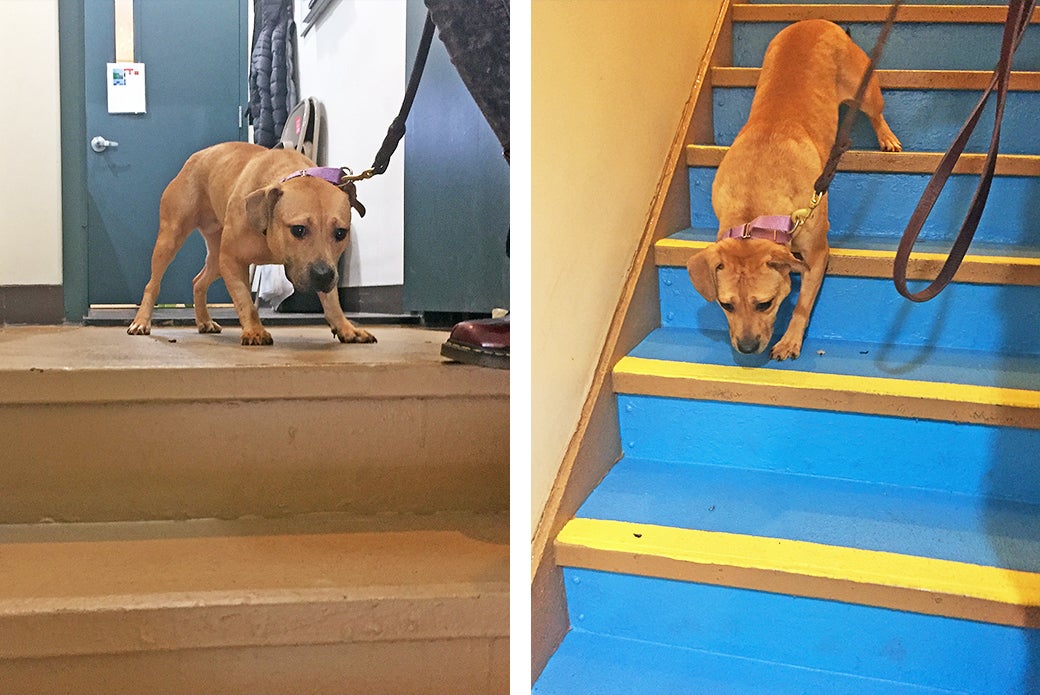
From the previous post, a dog is fearful and cautions at the ASPCA in NYC because she can’t judge the stairs because of the colors. I can relate! Notice her confidence and ease after the stairs were painted blue and yellow. Right on!
Long ago I painted a step and a ramp a lovely medium-sky-blue for my old dog Terra and she “miraculously” regained her ability to walk! Duh, because she could see the color!
For Fearful Dogs, a Fresh Coat of Paint Makes All the Difference
From the ASPCA website originally published July 12, 2016
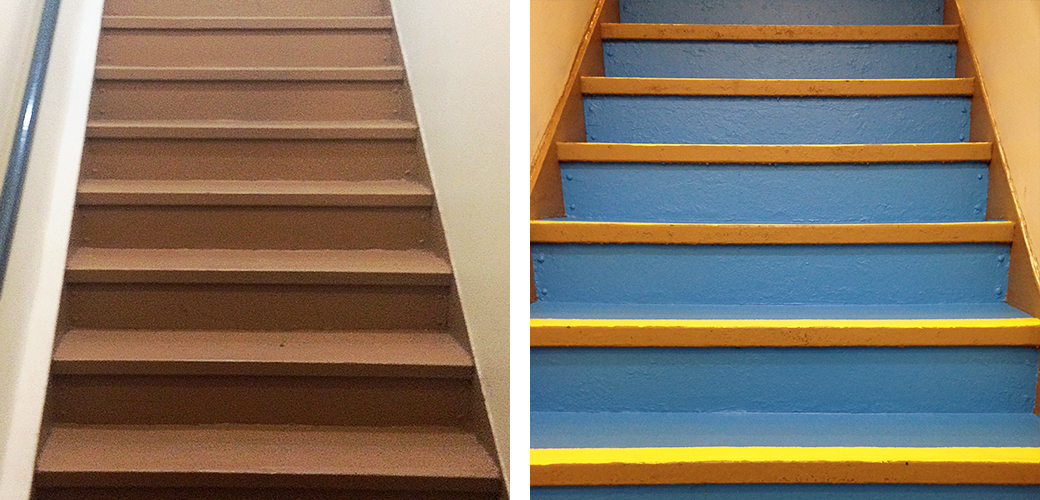
Before and after.
The crowded nature of New York City means that people—and buildings—are always moving upward rather than outward. At the ASPCA Adoption Center and Canine Annex for Recovery and Enrichment (CARE) in Manhattan, dogs must get used to riding in elevators and climbing stairs in order to go outside for walks. But for some dogs, stairs can be especially frightening.
“Many of the dogs we work with have most likely never encountered stairs before,” says Victoria Wells, Senior Manager of Behavior and Training. “They have lived in basements, backyards and situations of extreme confinement.” Two such dogs are Coretta and Harriett.
Coretta, who was seized by the NYPD in January, once lived her life on chains with no protection from the elements or access to food and water, as did Harriett. Both were terrified of the stairs leading from their second-story kennels at CARE to the street below. But dogs housed and cared for at CARE must use the stairs at least four times a day, so the ASPCA behavior team suggested painting the monochromatic tan-colored stairs with colors used for dog agility equipment: blue and yellow.
Before and after: Coretta hesitates to climb down stairs prior to the new paint; afterward is much easier.
Why blue and yellow? Dogs have only two types of photoreceptors (blue and yellow), or cones, in their eyes, while humans have three (red, blue and yellow); photoreceptors transmit signals about color to the brain. “Blue and yellow are two of the colors that dogs see best,” says Dr. Erin Wilson, Director of Shelter Medicine at the ASPCA Adoption Center.
What humans process as red, orange, yellow or green can appear as different concentrations of yellow to dogs. Blue-green, blue and violet appear as saturations of blue. Colors like green or red are not distinguishable. Simply put, a canine’s color vision is not as rich or intense as that of humans.
“It can be easier for some dogs to walk up stairs as opposed to going down because they can perceive how steep each stair is,” says Victoria. She adds that dogs with physical disabilities such as visual impairments, orthopedic issues, and short, stocky legs—like bulldogs, whose breathing problems can also create challenges—often have the most difficult time navigating stairs.
Before the stairs were re-painted, “Dogs had trouble discerning where one step ends and another begins,” explains Gail Buchwald, Senior Vice President of the Adoption Center. But afterward, staff noticed immediate changes in the dogs’ confidence.
The biggest impact has been on Harriett, according to Animal Behavior Counselor Jennifer Gerrity, who presented the initial idea to paint the stairs. Once very nervous, “Harriett now charges up and down,” Jennifer says.
Despite the challenges of big city life, these vulnerable animals are indeed learning to step up.
Bark Mitzvah. Get it?! It’s so funny and sweet and caring and playful! In use since 1958. Who knew?! Not me!
No disrespect is meant, merely reverent fun honoring a wise tradition that expands the circle of blessing to the more-than-human world.
Wikipedia say this about it:
A Bark Mitzvah is an observance and celebration of a dog’s coming of age, like the Jewish traditional Bar Mitzvah and Bat Mitzvah. The term has been in use since at least as early as 1958 and Bark Mitzvahs are sometimes held as an adjunct to the festival of Purim for fun.
The Bark Mitzvah is a self-styled tongue-in-cheek dog “coming of age” celebration occasionally held by Jews for their pets. It is not necessarily held in conjunction with a specific age, but can occur when the dog turns 13 months or 13 years of age. During some Bark Mitzvahs, dogs wear a tallit, a ritual prayer shawl worn during Jewish religious services and ceremonies. A male dog wears a specific yarmulke, a thin skullcap.
The first recorded Bark Mitzvah took place in Beverly Hills California in 1958. According to the Beverly Hills Courier, Max and Janet Salter celebrated the coming of age of their black Cocker Spaniel Duke of Windsor (Windy for short). Janet coined the term “Bark Mitzvah” on the invitations. Over the next 50 years, Max and Janet threw several more Bark Mitzvahs whenever one of their dogs turned 13.
Here is a book about it, too!In 1997, the first widely recorded Bark Mitzvah was celebrated, receiving scrutiny and disapproval from several rabbis. One rabbi expressed his distaste for Bark Mitzvahs in a letter to the editor of The New York Times, describing the celebration as “nothing less than a desecration of a cherished Jewish tradition” and claiming that Bark Mitzvahs “degrade some of the central principles of Jewish life”.
Although the idea of the Bark Mitzvah is frowned upon by some, the idea spread throughout the United States, and the celebrations have continued to occur. The ceremonies became increasingly popular on the East and West Coasts in the early 2000s. As a result, specialty pet stores and dog bakeries now offer special Bark Mitzvah party packages, party favors, and gifts.
For those of you who grew up in the San Francisco bay area in the 1960s you will likely remember these huge dog heads that were on top of each Doggie Diner, the local chain of casual diners. I think they rotated around and around.
I grew up with Dachshunds so I thought it made perfect sense to see our Doxies celebrated like this.
Is there still one dilapidated head in a side yard of a house in Emeryville?
Photo by Allysyn Kiplinger, 2005
I used to pass this building in Berkeley on my errand route. The sight was always provocative, dilapidated, curious, and so cool that the old painted company name was untouched.
Just a cool picture of dog things of days gone by.
Dogs in a Market Listen to Rūmī, Who Praises their Understanding and Attention
Love Dogs
by Rumi
One night a man was crying,
“Allah, Allah!”
His lips grew sweet with the praising,
until a cynic said
“So! I have heard you
calling out, but have you ever
gotten any response?”
How do you know when it’s time to release your animal friends from their bodies?
Some of our old dogs leave their bodies without assistance from us. Their deaths are “natural” and require no intervention. However, one of the most difficult, yet very necessary, aspects of our work here at Old Dog Haven is making the decision to allow dogs to move on to their next expressions of spirit when their bodies fail them and their quality of life becomes seriously compromised. These dogs depend on us to help them make their transition, and we perform that final service for them with love and respect.
We know that many people who find their way to our website share their homes with old dogs, and it is our hope that the following thoughts may be of help to those people who are agonizing over the end-of-life decisions that often must be made with regard to an animal friend: (Note: We’ve used the generic “him” to refer to individual dogs rather than the awkward “him/her” references.)
Quality of life is the key issue. If your animal friend is unable to function in a way that assures you that he is still enjoying a good quality of life, then it’s time to seriously consider releasing him from his body. Severe incontinence caused by kidney failure, inability to eat, impaired mobility, lack of interest in surroundings, restless movement during sleep often caused by pain, disorientation and confusion, severe vomiting, uncontrollable diarrhea, failed vision and hearing loss are all symptoms which indicate that your friend’s body is failing.
If you haven’t already done so, make an appointment with your veterinarian to determine the seriousness of the symptoms. Ask for a blood analysis, have x-rays taken if necessary, and in short, have your veterinarian perform whatever diagnostic tests might be helpful. If there is no treatment available to radically alter the symptoms you are seeing, then it’s time to release your friend.
Within this context, be very careful about having painful treatments or heroic surgery performed on an old dog that is suffering. He doesn’t deserve to endure more pain just because you don’t want him to die. We don’t ever want our animal friends to die, but that wanting is unreasonably self indulgent, and allowing them to waste away and suffer isn’t fulfilling your promise to care for them in all phases of their lives.
Don’t procrastinate just because the decision you face is a difficult one. Have the strength to do the right thing because you love and respect your animal friend. Indulging in “Maybe he’ll be better tomorrow” thoughts only prolongs the inevitable, and will surely invite you to revisit those thoughts with strong feelings of guilt at a later date because you waited too long.
Trust your intuition and rely on your connection with your animal companion. Put aside your own unwillingness to let your friend go because you will miss him. This time in your animal friend’s life is not about you. It’s about showing him that you love him enough to let him go.
Talk to your dog about your concerns. You’ve established a pattern of communication with your dog that works for both of you. Let your friend know that you think it may be time to let him go. Trust that he will hear you and understand that you’re ready to release him. Dogs are very loyal and intuitive companions, and if your friend understands that you’re ready, he will rest easier knowing that peace will soon come to him. Don’t even doubt for one minute that your friend will hear you. Dogs know what we’re thinking and feeling — often far better than we do — and your thoughts and feelings will be heard.
Allysyn Kiplinger of Sugar Face Dogs with Anna Belle (black Lab) at George’s side for his euthanasia at Creature Comfort Vet, Oakland, CA, 2019.
If you are able to draw on your reserve of strength to make the decision necessary to release your friend from his body, reach inside of yourself one more time and stay with your dog after you bring him to the veterinarian to have the injection administered that will send your friend on his way. (Some veterinarians will come to your home if you’d prefer to have your friend leave in a familiar setting, and if you are able to arrange this, that’s the best possible way of saying good-bye.) Regardless of location, your presence is very important at this most difficult time. Being able to hold your dog and feel all of the pain and discomfort slip away is a necessary conclusion to your physical friendship. Ask the veterinarian to sedate your friend so there is absolutely no discomfort involved for either of you.
Understand that death is just change. Certainly you will grieve for the loss of your animal friend’s physical presence, but know that you will always carry the love you shared with you. That permanence of spirit never changes.
We hope that these thoughts are of some help to you as you face end-of-life decisions involving your animal friends. If you feel a need to talk with someone about this topic, please contact the author and pet loss counselor at Old Dog Haven, Ardeth De Vries, at ardethdv@comcast.net
Ardeth De Vries is the author of Old Dog Haven: Every Old Dog Has a Story to Tell. Another will be published at the end of 2023 called When I Grow Old I Will Wear Flowers: Thoughts About Senior Dogs.



 as an adjunct to the festival of Purim for fun.
 For those of you who grew up in the San Francisco bay area in the 1960s you will likely remember these huge dog heads that were on top of each Doggie Diner, the local chain of casual diners. I think they rotated around and around.

 Quality of life is the key issue. If your animal friend is unable to function in a way that assures you that he is still enjoying a good quality of life, then it’s time to seriously consider releasing him from his body. Severe incontinence caused by kidney failure, inability to eat, impaired mobility, lack of interest in surroundings, restless movement during sleep often caused by pain, disorientation and confusion, severe vomiting, uncontrollable diarrhea, failed vision and hearing loss are all symptoms which indicate that your friend’s body is failing.
 Don’t procrastinate just because the decision you face is a difficult one. Have the strength to do the right thing because you love and respect your animal friend. Indulging in “Maybe he’ll be better tomorrow” thoughts only prolongs the inevitable, and will surely invite you to revisit those thoughts with strong feelings of guilt at a later date because you waited too long.